


7 Best Quiet Garage Door Openers for Homes
A garage door opener should not wake a sleeping baby, shake the room above the garage, or announce every early-morning departure to the neighborhood. The best quiet garage door openers reduce motor noise and vibration, but the opener is only part of the equation. A worn roller, loose track, weak spring, or unbalanced door can make even a premium opener sound rough.
For homeowners in Greater Cincinnati, Loveland, and Northern Kentucky, a quiet opener is usually worth the investment when the garage sits below a bedroom, beside a living space, or connects directly to the home. Here is what to look for before choosing one.
What Makes a Garage Door Opener Quiet?
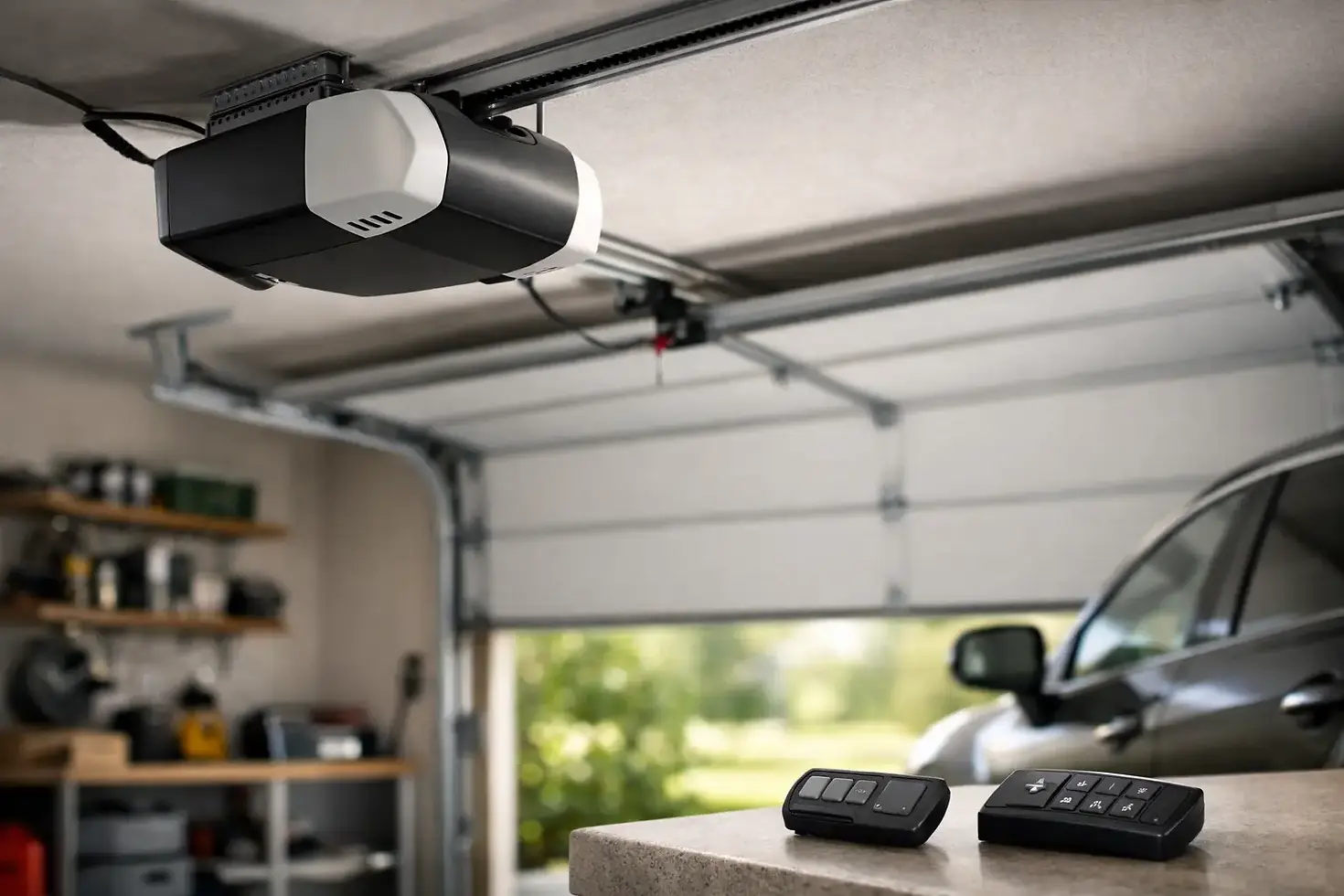
The quietest residential setups usually pair a DC motor with a belt-drive rail. A belt uses reinforced rubber rather than a metal chain, so it produces less clatter as the trolley moves. DC motors also tend to start and stop more gradually than older AC motors, which helps cut down on vibration.
That does not mean a chain-drive opener is automatically a bad choice. Chain drives are dependable, cost-effective, and often a practical option for detached garages or heavy doors. But if the garage is attached to the house, especially with a bedroom overhead, a belt drive is typically the better answer.
A wall-mount opener can be even quieter in the room above the garage because it eliminates the ceiling-mounted motor and rail. It attaches beside the door at the torsion bar, leaving the ceiling open for storage and reducing vibration transfer through framing. It does require the right side clearance and a properly functioning torsion spring system.
7 Best Quiet Garage Door Opener Options
The right choice depends on your door weight, ceiling height, smart-home needs, and budget. These are the opener styles and product families we most often recommend for quieter residential operation.
1. LiftMaster DC Belt-Drive Openers
LiftMaster belt-drive models are a strong choice for attached garages because they combine smooth DC operation with durable belt rails. Many current models include Wi-Fi control through myQ, integrated LED lighting, and battery backup options.
They are a good fit for homeowners who want professional-grade equipment and dependable daily use. The trade-off is price. LiftMaster openers generally cost more than basic retail units, but they are built for long-term service and are widely supported by professional garage door technicians.
2. Chamberlain Smart Belt-Drive Openers
Chamberlain is often the practical homeowner-focused alternative for quiet belt-drive performance. Many models offer myQ smartphone control, bright LED lighting, and camera or battery backup features depending on the model.
This is a sensible option when you want useful smart features without paying for more commercial-style hardware than your home needs. Before choosing a model, verify whether battery backup is included or optional. It matters during power outages, particularly if the garage is your main way in and out of the house.
3. Genie StealthDrive Connect Models
Genie StealthDrive openers use quiet DC motors and belt-drive systems designed for homes with living areas near the garage. They are known for a compact design and straightforward operation, with smart control available on connected models.
Genie can be a good middle-ground choice for a standard sectional door in good condition. The model still needs to be matched to the door. A heavier insulated door, wood door, or oversized door may need a higher-capacity opener and the right springs before installation.
4. Wall-Mount Openers From LiftMaster or Chamberlain
For noise control and ceiling clearance, a wall-mount opener is hard to beat. LiftMaster and Chamberlain wall-mount designs move the motor from the ceiling to the side of the garage door, which can noticeably reduce the rumble felt in rooms overhead.
This option works especially well in garages with tall ceilings, overhead storage, or a finished room above. It is not a universal fit, though. The door needs a torsion spring shaft, adequate side room, and correctly adjusted springs. A professional inspection can confirm whether the setup is suitable.
5. Sommer Direct-Drive Openers
Sommer direct-drive openers use a different design from traditional ceiling-mounted units. Instead of a moving trolley being pulled along the rail by a motor, the motor itself travels along the rail. Fewer moving components can mean less vibration and a very smooth sound profile.
For homeowners focused almost entirely on quiet operation, a direct-drive opener is worth considering. Availability, local parts support, and installer familiarity can vary, so it is smart to ask about service options before making this selection.
6. A Belt-Drive Opener With Battery Backup
Battery backup does not make an opener quieter, but it makes a quiet opener more useful when the power goes out. The battery allows the door to operate for a limited number of cycles during an outage, so you are not stuck outside or forced to use the emergency release.
This is one of the best upgrades for attached garages and households that rely on the garage as their primary entrance. Make sure the battery is tested periodically. Like any rechargeable battery, it will eventually need replacement.
7. A Quiet Opener Paired With a Door Tune-Up
Sometimes the best quiet opener is not a new opener at all. If your existing opener is reasonably modern but the door bangs, squeaks, rattles, or strains, the problem may be in the door system. Nylon rollers, properly lubricated hinges, tightened hardware, aligned tracks, and balanced springs can make a major difference.
A garage door should stay roughly in place when disconnected from the opener and lifted halfway by hand. If it races up, drops down, or feels unusually heavy, stop using the opener and schedule service. The opener is not designed to compensate for broken or poorly adjusted springs.
Features Worth Paying For
A quiet drive system matters most, but a few other features can improve daily use. Battery backup is valuable during Cincinnati-area storms and outages. Smart control lets you check whether the door is open, receive activity alerts, and close it remotely when appropriate. Motion-activated LED lighting is useful because it stays bright in cold temperatures and does not require frequent bulb replacement.
A soft-start and soft-stop motor is another feature worth having. It reduces the abrupt movement that can shake the door and create extra noise. If security is a concern, consider a model with automatic closing settings, app alerts, and a camera. Those features add convenience, but they should not replace a properly maintained door, secure locks, and working safety sensors.
Do not choose an opener based on horsepower wording alone. Door balance, spring condition, door material, width, height, and wind load all affect what the opener needs. A well-balanced insulated steel door may run quietly on a properly selected standard residential opener, while a heavy custom wood door may require a more specialized setup.
Installation Details That Affect Noise
Even the best equipment can be noisy when installation is rushed. The rail must be supported correctly, the opener should be mounted with appropriate brackets, and the door needs to travel smoothly through the full opening and closing cycle. Loose bolts, worn rollers, bent track, or a vibrating support bracket can create the familiar banging sound homeowners blame on the motor.
Safety sensors also need attention. They should be aligned, securely mounted, and kept clear of dirt, cobwebs, snow, and storage items. If your opener reverses unexpectedly or will only close when you hold the wall button, do not disable the sensors. That is a safety issue that needs to be corrected.
At Fix My Garage Door, we often find that quieter operation comes from treating the whole system, not simply replacing the opener. A professional can inspect the springs, cables, rollers, hinges, tracks, and opener settings at the same visit, helping prevent a new opener from being installed on a door that is already working too hard.
When to Repair Instead of Replace
Replacement makes sense when an opener is unreliable, lacks modern safety features, has a failing motor or circuit board, or cannot support the door properly. It also makes sense when you want battery backup, smartphone control, a camera, or a significantly quieter belt-drive or wall-mount system.
Repair may be the better value when the opener itself works but the door is noisy or inconsistent. Replacing worn rollers, lubricating moving parts, correcting track issues, or repairing a sensor problem can restore smooth operation at a lower cost. The key is identifying the real source of the noise before buying equipment.
If your garage door suddenly becomes loud, jerky, or difficult to open, do not wait for the opener to fail completely. A quick inspection can protect the opener, keep the door secure, and make every trip in and out of the garage a lot quieter.


Comments